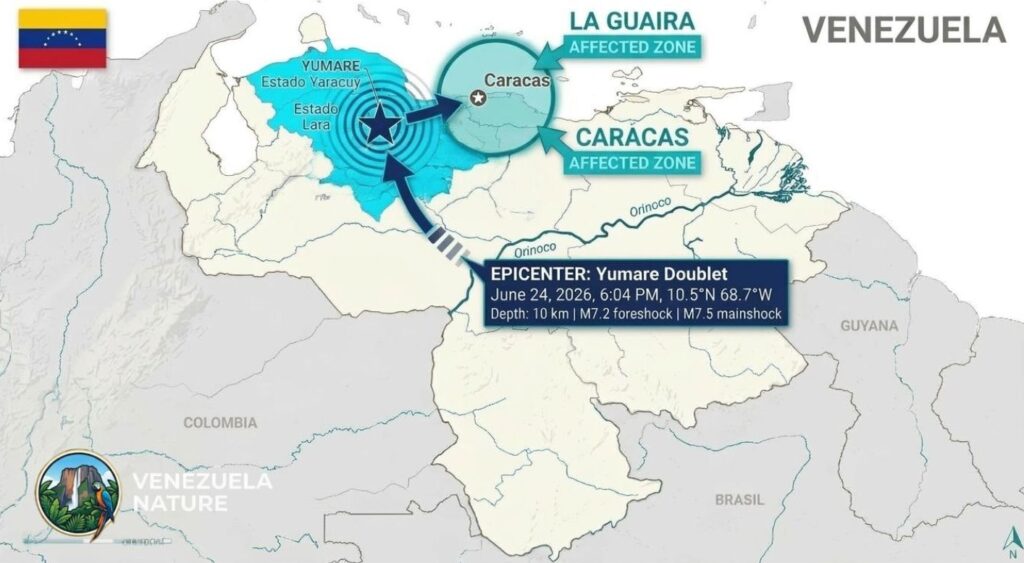
On June 24, 2026, at 6:04 p.m. local time, northern Venezuela was struck by two powerful earthquakes in rapid succession. A magnitude 7.2 earthquake hit first, followed just 39 seconds later by an even stronger magnitude 7.5 earthquake. Together, they form what seismologists call a doublet earthquake: a rare pairing of two large quakes close in both location and time. The result was Venezuela’s most destructive seismic event in more than a century, with a death toll that climbed past 920 within two days and thousands more injured or missing.
The sequence exposed how vulnerable the country’s northern cities, including Caracas and the coastal city of La Guaira, remain to seismic events. Decades of economic strain have left many buildings without adequate reinforcement, and the rapid back-to-back shaking gave structures almost no time to recover between impacts.
For those of us watching from abroad, understanding what happened and how to respond matters now more than ever. If you want to take action, organizations such as UNICEF, the Red Cross, and Caritas Venezuela are already mobilizing on the ground, and reaching out to them directly is a meaningful first step.
Key Takeaways
Two large earthquakes struck northern Venezuela just 39 seconds apart on June 24, 2026, forming an exceptionally rare seismic doublet.
The region’s tectonic setting, aging building stock, and amplifying soils near Caracas combined to make the damage far worse than either quake alone would have caused.
International readers can support recovery by donating to vetted humanitarian organizations already operating in Venezuela and by verifying appeals before sending money.
What Happened On June 24
The June 24 sequence unfolded with almost no warning and no gap between the two events long enough for most people to reach safety. The two earthquakes were separated by epicenters roughly three miles apart and by just 39 seconds of clock time, creating an experience of near-continuous violent ground shaking for communities across northern Venezuela.
The Two Quakes In The First Minute
The magnitude 7.2 earthquake struck first at 6:04 p.m. local time, generating severe ground shaking across a wide swath of the country’s northern coast. Before most buildings had stopped swaying, the magnitude 7.5 mainshock followed. The USGS classified this as an earthquake doublet and noted that the closely spaced timing subjected northern Venezuela to two rounds of severe shaking in under a minute.
The twin quakes were the strongest to hit Venezuela in more than a century. The USGS projected that high casualties and widespread damage were probable even in its earliest assessments. By Friday, June 26, authorities confirmed at least 920 deaths, with thousands more injured and still others unaccounted for.
Where The Earthquake Epicentres Were Located
Both earthquake epicentres were located near the city of Morón, along Venezuela’s Caribbean coast, roughly 160 kilometers west of Caracas. The proximity of these epicentres to densely populated coastal cities meant that the energy from both events radiated directly into urban areas with little geographic buffer.
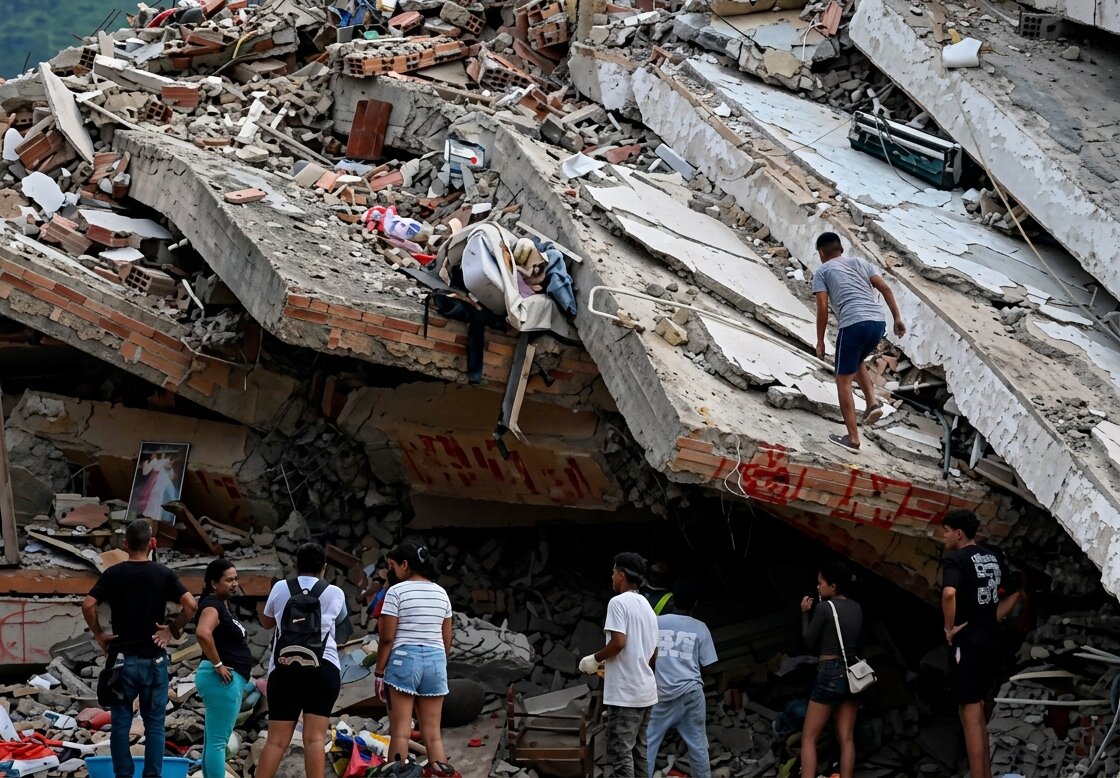
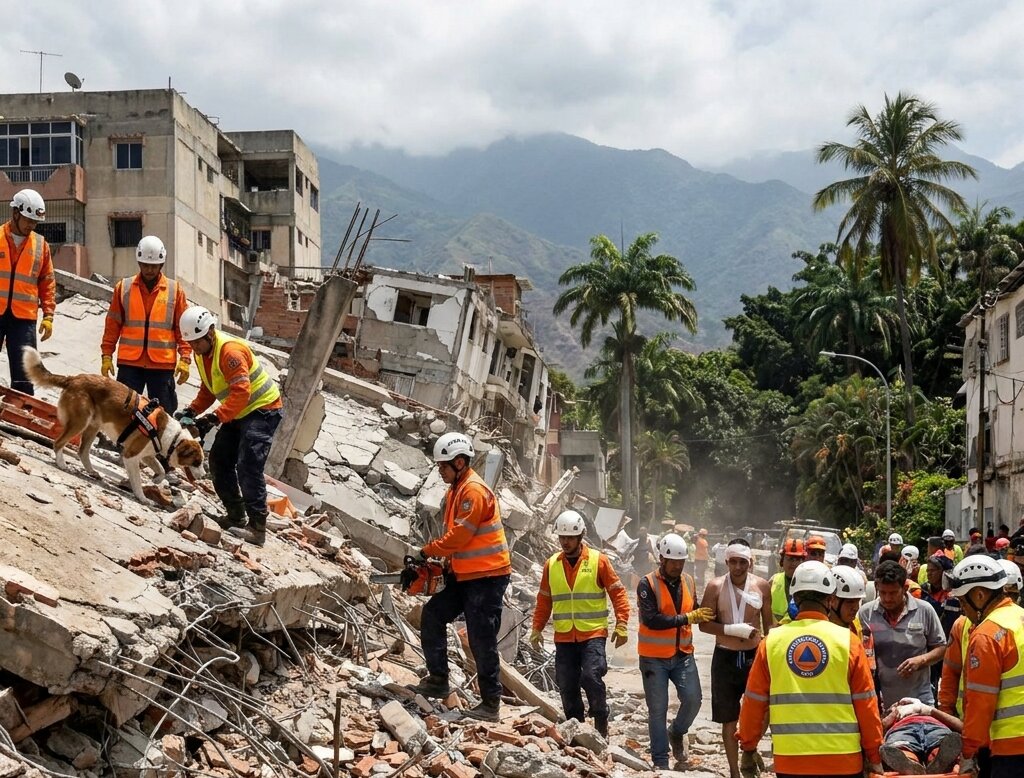
La Guaira, Caracas, and surrounding states absorbed the most severe structural damage. Entire buildings were reported reduced to rubble in both cities, with search-and-rescue operations still ongoing as of this writing.
Why The Damage Escalated So Quickly
A key reason the damage was so severe is the compounding effect of twin quakes. The first earthquake weakened buildings and infrastructure by forcing them through cycles of stress they were not designed to absorb repeatedly. The second, stronger earthquake then struck those already-compromised structures while shaking was still underway or had barely subsided.
Many of the buildings that collapsed were made of unreinforced brick masonry, adobe block construction, or older non-ductile concrete, materials that tolerate very little movement before failing. Venezuela’s current seismic building code dates to 1982, and many structures predate those standards entirely.
What A Doublet Earthquake Means
A doublet earthquake is not simply a large earthquake followed by a smaller aftershock. It is a specific and rare pattern in which two large earthquakes of comparable magnitude occur close together in time and space, with neither fitting neatly into the typical main shock and aftershock model that most people expect.
How A Doublet Differs From A Normal Aftershock Pattern
In a typical earthquake sequence, one large main shock is followed by progressively smaller aftershocks. The main shock releases the most energy, and subsequent events are noticeably weaker. A doublet breaks that pattern: both earthquakes are large, and neither clearly dominates as the single main shock in the conventional sense.
On June 24, the magnitude 7.2 and the magnitude 7.5 were close enough in size that the USGS classified the sequence as a doublet rather than a main shock with a foreshock. This distinction matters practically because it means the energy release was split across two major ruptures rather than concentrated in one event followed by a gradual decay.
Why Seismologists Are Debating The Sequence
Seismologists are actively discussing whether the two ruptures involved a single complex fault or two separate but related fault structures. Several faults intersect in northern Venezuela’s tectonically complex zone, making it difficult to definitively assign each earthquake to a single source.
Some researchers have suggested the event may have functioned almost as a single giant rupture that split across fault segments. Others argue the two ruptures are distinct events on neighboring structures. That debate will continue as more seismic data is processed in the weeks ahead.
How Seismic Waves Can Trigger A Second Major Rupture
One explanation for doublet earthquakes is that seismic waves from the first rupture travel along nearby fault segments and push those segments closer to their own failure threshold. If a neighboring fault segment is already under stress, the additional loading from the first earthquake’s seismic waves can be enough to trigger a second major rupture within seconds.
This process, sometimes called dynamic triggering, is not fully predictable. It depends on the stress state of nearby faults at the exact moment the waves arrive, which is why doublet earthquakes are rare but possible in any tectonically active region with multiple proximate fault structures.
Why Northern Venezuela Is Seismically Active
Northern Venezuela sits at the boundary between two major tectonic plates, and the region has accumulated significant geological complexity over millions of years. The area’s seismic history is long and well documented, and the June 24 doublet is part of that ongoing pattern rather than an anomaly.
The Caribbean Plate And South American Plate Boundary
The fundamental driver of earthquake activity in this region is the interaction between the Caribbean plate and the South American plate. These two plates move roughly parallel to each other in a lateral sliding motion, but the boundary between them is not a single clean line. It is a diffuse onshore boundary spread across a wide zone of northern Venezuela and the southern Caribbean.
This diffuse character means seismic energy can be released across a broader area rather than along one clearly defined line, making the region’s seismic hazard harder to map with precision and harder to prepare for with certainty.
El Pilar Fault System And Other Regional Fault Systems
The most prominent feature of this tectonic zone is the El Pilar fault system, a long east-west striking fault that runs across northern Venezuela near the Caribbean coast. The El Pilar fault is a strike-slip fault, meaning the two sides of the fault move horizontally past each other rather than one side pushing up over the other.
Several other fault systems intersect and branch off from this main structure across the region. Scientists studying the June 24 sequence believe that one or more of these related fault systems may have been involved in producing the doublet.
Why Strike-Slip Faults Matter In This Region
Strike-slip faults like the El Pilar fault are geologically similar to California’s San Andreas fault, and the comparison is instructive. They can accumulate stress over long periods and release it suddenly in large, damaging earthquakes. They also tend to produce shallow earthquakes, meaning the rupture occurs close to the surface.
Shallow earthquakes are typically more destructive than deeper ones because the seismic energy has less distance to travel and less rock to attenuate it before reaching buildings and people at the surface. The June 24 earthquakes were shallow, which contributed directly to the intensity of ground shaking felt in coastal cities.
Why The Impact Was So Severe Near Caracas And The Coast
Even at a distance of roughly 160 kilometers from the epicentres, Caracas suffered severe damage. That distance would normally attenuate some seismic energy, but several compounding factors erased much of that buffer and left the city highly exposed.
Sediment, Amplified Shaking, And Urban Vulnerability
Much of Caracas sits on sediment-filled valleys. Soft sediment amplifies seismic waves, meaning ground shaking can be significantly stronger in areas built on alluvial soils than in areas built on solid bedrock, even when those areas are at the same distance from the earthquake epicentre.
This amplification effect is well understood in seismology and has been documented in past Caracas earthquakes. It means that the city’s geology itself magnifies the danger during any major regional earthquake, regardless of which specific fault produces the event.
Liquefaction, Ground Failure, And Slope Failures
Beyond amplified shaking, the June 24 sequence produced conditions favorable to liquefaction and slope failures in vulnerable areas. Liquefaction occurs when saturated loose sediment temporarily loses its strength during shaking and behaves more like a liquid than a solid, causing the ground beneath buildings to shift or sink unpredictably.
The mountainous terrain surrounding Caracas and the coast also created conditions for slope failures. When seismic waves travel through steep hillsides, they can trigger landslides and debris flows that destroy infrastructure independently of direct structural damage from the shaking itself. Ground failure of this kind adds a secondary layer of destruction on top of the primary earthquake damage.
What The Caracas Earthquake History Tells Us
Caracas has experienced damaging earthquakes before. A magnitude 6.3 earthquake struck the city in 1967, killing more than 200 people and injuring hundreds more. That event prompted Venezuela to update its seismic building codes in 1982, introducing standards intended to reduce vulnerability.
The problem is that buildings constructed before 1982 still stand throughout the city, and economic conditions over recent decades have limited enforcement of even modern standards. Many residents live in structures that were never engineered to survive ground shaking of this intensity, which is why the human cost of the June 24 doublet has been so severe.
What Comes Next For Rescue And Risk Monitoring
The immediate priority in the days following the June 24 earthquakes is locating and extracting survivors from collapsed structures. Search-and-rescue teams from Venezuela and several international partners are working across affected areas, but conditions are complicated by ongoing aftershocks, unstable rubble, and the country’s existing logistical challenges.
Aftershocks And Ongoing Hazards
After a doublet earthquake of this size, aftershocks are expected to continue for weeks or even months. Some aftershocks may themselves be strong enough to cause additional damage to already-weakened buildings. Residents in affected areas are being urged by authorities to avoid re-entering structurally compromised structures until they have been assessed by engineers.
The shallow nature of the original earthquakes means that aftershocks are also likely to be felt intensely near the surface. Any significant aftershock in the days immediately following the main sequence carries elevated risk because so many structures are already partially damaged.
What USGS And Seismologists Will Be Watching
The USGS and regional seismologists will be monitoring the aftershock sequence closely to understand the geometry of the fault ruptures and assess whether additional large earthquakes in the sequence are possible. Seismologists use the distribution of aftershocks to map the fault surfaces that ruptured, which helps clarify whether one or two fault structures were involved in the doublet.
Probabilistic forecasting tools will be applied to estimate the likelihood of future significant earthquakes in the coming days and weeks. These forecasts carry real uncertainty, but they give emergency managers a statistical framework for maintaining evacuation orders and restricting access to damaged areas.
Why Information Quality Matters In The First Weeks
In the first weeks after a major earthquake sequence, information quality is often uneven. Death tolls change rapidly, damage assessments are incomplete, and social media can spread inaccurate reports about the scale of needs and the reliability of aid channels. Verifying information through established organizations and official government sources before acting on it is important, especially for anyone considering donating or traveling to assist.
Venezuela’s political situation adds an additional layer of complexity to information flow. Cross-referencing reports from multiple credible humanitarian organizations operating on the ground gives a more accurate picture than any single source.
How International Readers Can Support Recovery Responsibly
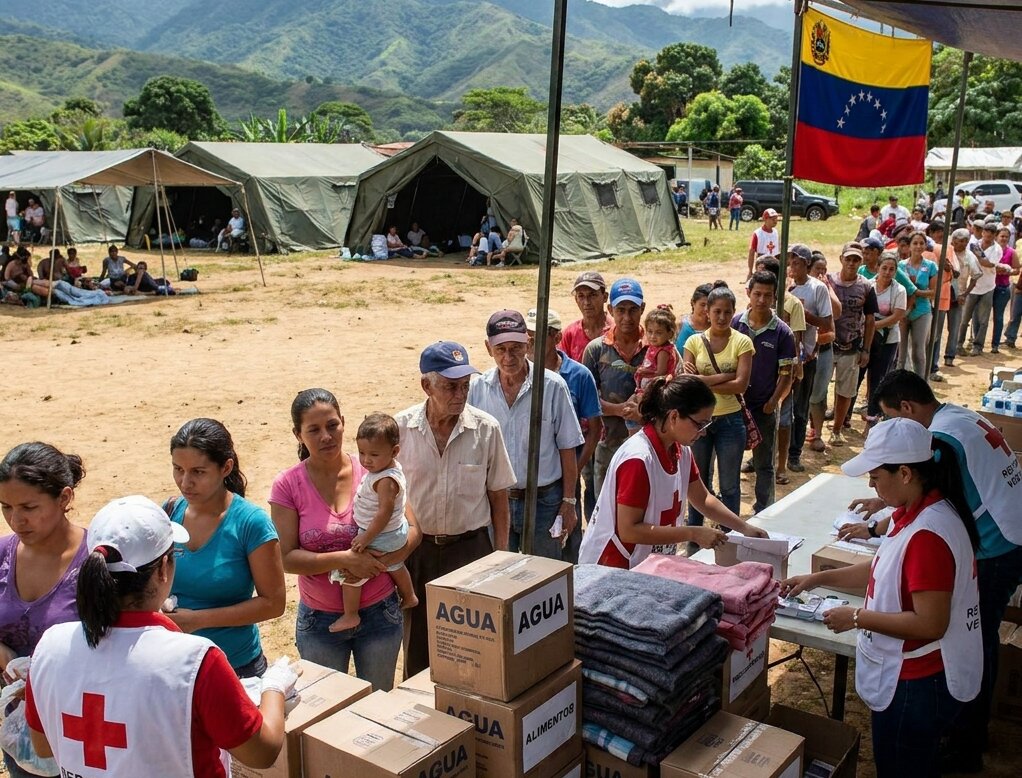
Supporting earthquake recovery from abroad is genuinely valuable, but it works best when donors take a few careful steps before sending money. Verified organizations with existing operations in Venezuela are far better positioned to use your support effectively than newly created emergency appeals with no track record.
Official Donation Links For Foreign Support
Several organizations with verified humanitarian operations in Venezuela are actively responding to the June 24 earthquakes. The following are worth considering for international donors:
UNICEF is coordinating child protection, water, and emergency supply distribution in affected areas.
Cruz Roja Venezolana (Venezuelan Red Cross) and the broader International Federation of Red Cross and Red Crescent Societies are on the ground with search, rescue, and medical support.
Caritas Venezuela has established local networks across the country and is responding to shelter and food needs.
World Central Kitchen has a history of rapid food deployment following disasters and has been active in Venezuela in recent years.
International Medical Corps is focusing on emergency health response in affected regions.
Save the Children is addressing the needs of children and families who have lost housing or access to services.
Médicos Sin Fronteras (Doctors Without Borders) is scaling up medical assistance where access allows.
Hazlo Hoy and Hogar Bambi are Venezuela-based civil society organizations that may have more direct access to specific communities.
Always visit each organization’s official website directly to find their current emergency appeal pages, confirm that donations are being directed to Venezuela earthquake relief specifically, and check their preferred transfer methods.
How To Vet Emergency Appeals Before Sending Money
Before donating to any appeal, take a few minutes to confirm the organization has an established presence in Venezuela, not just a recently launched campaign tied to the news cycle. Established humanitarian organizations publish financial transparency reports and operational updates you can review.
Be cautious of crowdfunding campaigns from individuals or newly created organizations with no verifiable history of work in Venezuela. If an appeal lacks a clear organizational name, registered address, or documented history of operations, that is a reason to pause. Charity watchdog tools such as Charity Navigator and GuideStar can help verify the credibility of U.S.-registered organizations.
Supporting Communities With Respect And Long-Term Perspective
Cash donations to credible organizations are generally the most flexible and impactful form of support in the immediate aftermath of a disaster. They allow organizations to purchase locally, which also supports the regional economy rather than bypassing it.
Long-term recovery in Venezuela will take years, not weeks. The earthquake struck a country already managing one of the world’s largest ongoing displacement crises, with nearly 8 million Venezuelans having left since 2014 and millions more still inside the country in need of humanitarian assistance. Sustained support after the immediate news cycle fades is often more valuable than a surge of one-time donations in the first days. If you are thinking about deeper engagement with Venezuela’s communities, including travel to support local economies in protected regions like the Orinoco Delta, Los Llanos, or the Caribbean coast once conditions allow, local operators such as Venezuela Nature can offer guidance on responsible, community-centered travel that channels resources directly to the people who live there.